Stone Stele Records
The stone steles were built from 1484 (the 15th Hong Duc year) to 1780 (the 41st Canh Hung year). They were inscribed with the names of Confucian doctoral laureates who passed the imperial examinations from 1442 (the 3rd Bao Dai year) to 1779 (the 40th Canh Hung year).
According to the “Dai viet su ky toan thu” (Complete Annals of Dai Viet), in the autumn of Canh Tuat Year (1070), King Ly Thanh Tong ordered the construction of Van Mieu in the south of the imperial city of Thang Long to worship the sages and saints and Confucian scholars who had rendered great services to the country. Among them were Confucius, the founder of Oriental Confucianism, and Chu Van An, a virtuous and venerable teacher in Vietnam. In 1076, King Ly Nhan Tong ordered the establishment of Quoc Tu Giam – the first university of Vietnam, next to Van Mieu, to train talent for the country.
During the reign of King Le Thanh Tong (1483), the king set out a regulation of engraving the names of those who passed the doctoral examinations on the stone steles which were erected at Van Mieu to honour their merits. After each student’s examination a new stele was erected. After more than 300 years, a total of 82 steles corresponding to 82 examinations were erected.
The first stele was built in 1484 during the reign of King Le Thanh Tong to record the history of the examination in 1442. The last stele was built in 1780 to record the history of the examination in 1779. According to statistics, the 82 steles were inscribed with the names of the 1,304 people who came in first in the exams. It is praiseworthy that almost all lineages in Vietnam had their members whose names were engraved in these special “rolls of honour”.
According to the “Dai viet su ky toan thu” (Complete Annals of Dai Viet), in the autumn of Canh Tuat Year (1070), King Ly Thanh Tong ordered the construction of Van Mieu in the south of the imperial city of Thang Long to worship the sages and saints and Confucian scholars who had rendered great services to the country. Among them were Confucius, the founder of Oriental Confucianism, and Chu Van An, a virtuous and venerable teacher in Vietnam. In 1076, King Ly Nhan Tong ordered the establishment of Quoc Tu Giam – the first university of Vietnam, next to Van Mieu, to train talent for the country.
During the reign of King Le Thanh Tong (1483), the king set out a regulation of engraving the names of those who passed the doctoral examinations on the stone steles which were erected at Van Mieu to honour their merits. After each student’s examination a new stele was erected. After more than 300 years, a total of 82 steles corresponding to 82 examinations were erected.
The first stele was built in 1484 during the reign of King Le Thanh Tong to record the history of the examination in 1442. The last stele was built in 1780 to record the history of the examination in 1779. According to statistics, the 82 steles were inscribed with the names of the 1,304 people who came in first in the exams. It is praiseworthy that almost all lineages in Vietnam had their members whose names were engraved in these special “rolls of honour”.
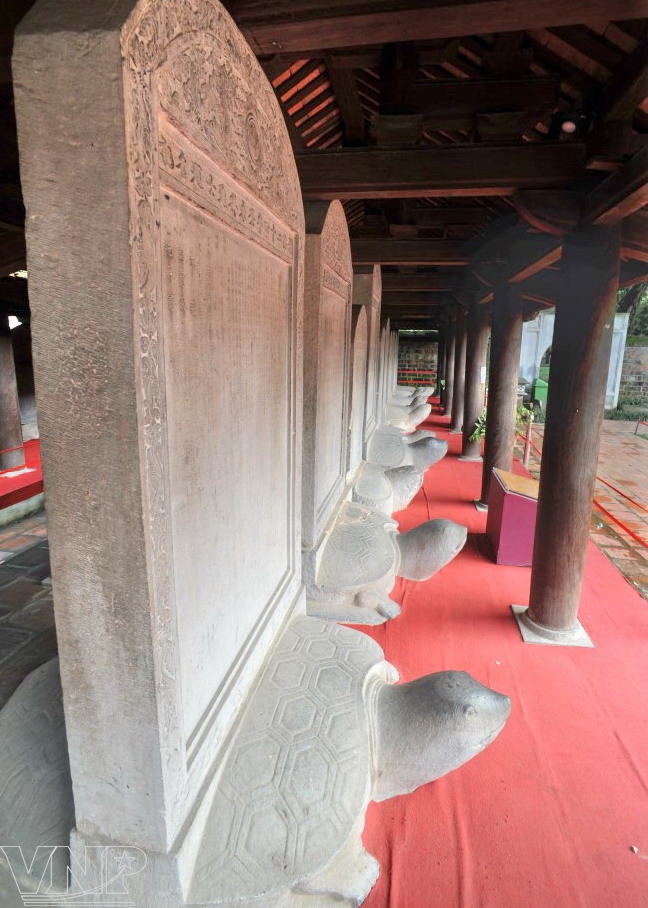 The stone stele records of doctoral laureates in Van Mieu – Quoc Tu Giam, Hanoi. Photo: Tran Thanh Giang 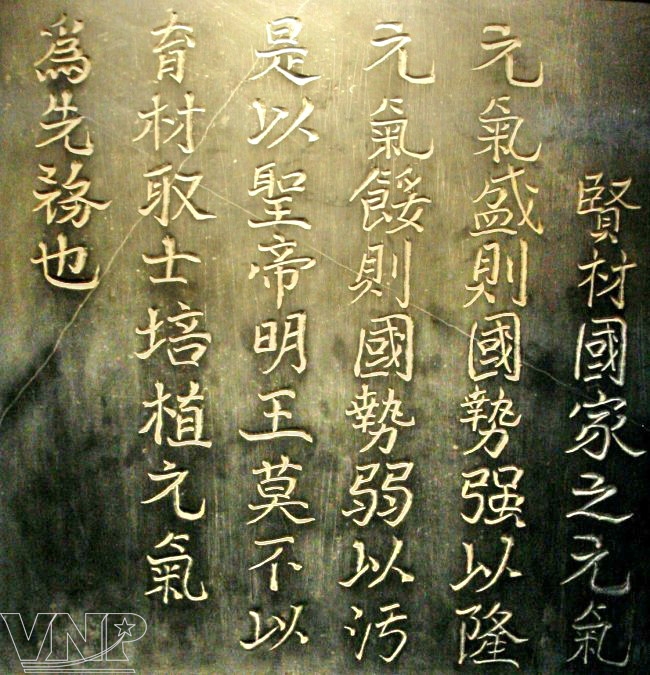 Inscriptions on a stone stele record of the imperial examination in Nham Tuat Year (1442). Photo: Hoang Giap 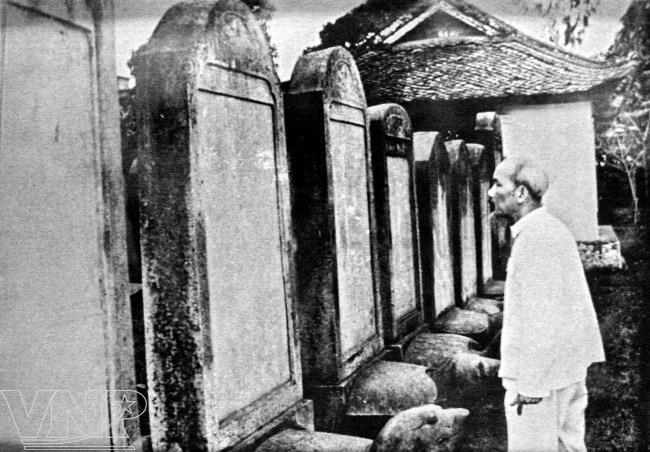 President Ho Chi Minh visited the stone stele records in 1960. Photo: File  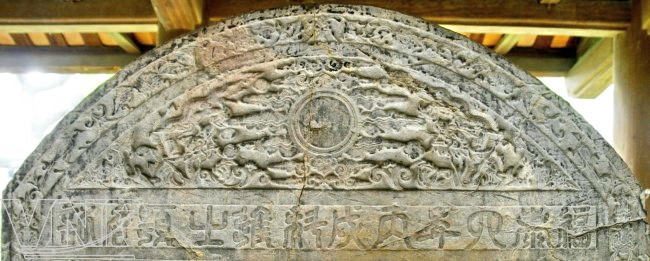 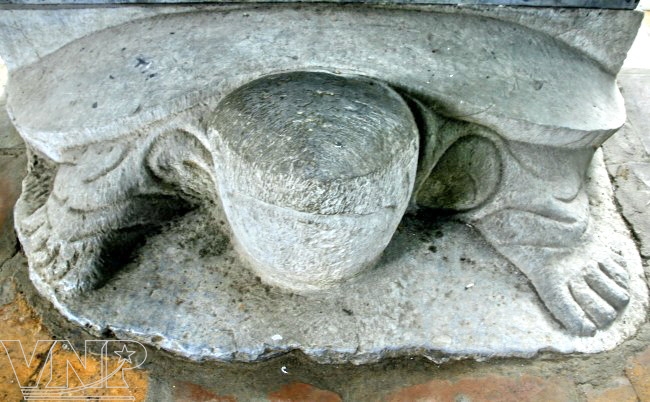 Stone tortoises and the top of a stone stele. Photo: Hoang Giap 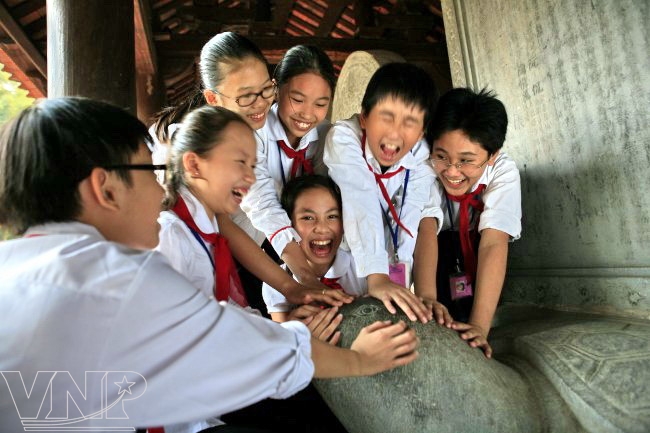 Students rub the head of a stone tortoise and hope to pass their exam. 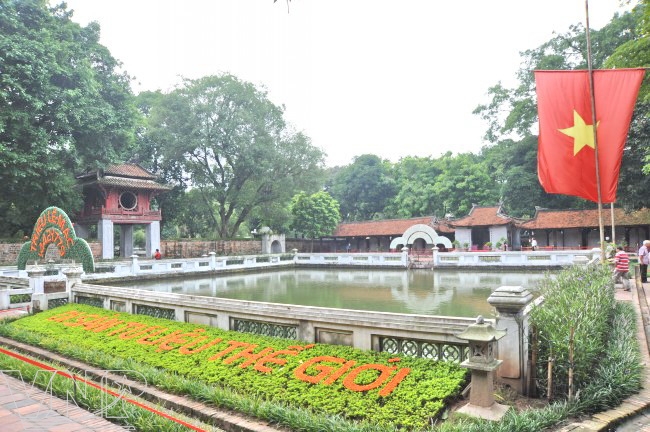 The stone stele records of the imperial examinations in Van Mieu have been recognized as a World Documentary Heritage. Photo: Tran Thanh Giang 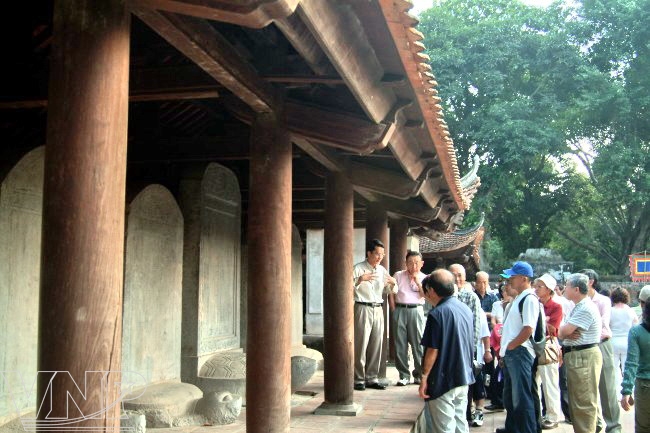 Foreign visitors listen to an introduction about the stone steles. Photo: Dinh Cong Hoan 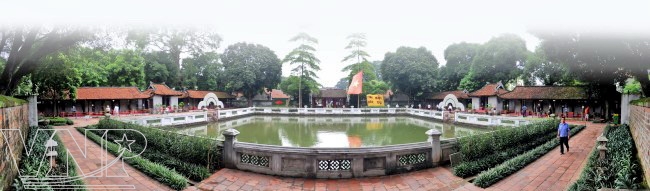 The whole area of the doctoral laureate steles in Van Mieu – Quoc Tu Giam, Hanoi. Photo: Tran Thanh Giang |
Each stele is a record in Chinese script composed by the most famous scholars. These records describe the examinations, names of the examiners, exam regulations and a list of the laureates with their full name, birthplace and achievements. This shows the enhancement of learning and the policy of respecting the talent of the feudal dynasties in the past.
The first stele built in 1484 that records the examination in 1442 has a famous statement: “Excellent talents with good virtue are the sap of the country. If the sap is strong, the country will be strong and progress. If the sap is weak, the country will weaken and degrade. For that reason there is no clear-sighted king who is not concerned about building and developing talent.”
Other steles also have such standard and strong literary statements which were carefully composed to enhance the use of the talented and righteous people of each dynasty as well as to remind the laureates to devote their talent to the country.
In the countries influenced by Confucianism like China, South Korea, Japan and Vietnam, only Vietnam has stone stele records of doctoral laureates which reflect the political ideology, philosophy, education and examinations of the dynasty. Thus, through the contents of the steles people can research to learn about the impact of Confucianism on the policies of governing the country of the past feudal dynasties.
It may be said that each stele in Van Mieu – Quoc Tu Giam has value not only in terms of architecture but also in terms of history and learning. Through historical ups and downs, the stone steles have remained intact and have become a huge treasure of historical records of great value which are worthy for people to research and learn from.
The first stele built in 1484 that records the examination in 1442 has a famous statement: “Excellent talents with good virtue are the sap of the country. If the sap is strong, the country will be strong and progress. If the sap is weak, the country will weaken and degrade. For that reason there is no clear-sighted king who is not concerned about building and developing talent.”
Other steles also have such standard and strong literary statements which were carefully composed to enhance the use of the talented and righteous people of each dynasty as well as to remind the laureates to devote their talent to the country.
In the countries influenced by Confucianism like China, South Korea, Japan and Vietnam, only Vietnam has stone stele records of doctoral laureates which reflect the political ideology, philosophy, education and examinations of the dynasty. Thus, through the contents of the steles people can research to learn about the impact of Confucianism on the policies of governing the country of the past feudal dynasties.
It may be said that each stele in Van Mieu – Quoc Tu Giam has value not only in terms of architecture but also in terms of history and learning. Through historical ups and downs, the stone steles have remained intact and have become a huge treasure of historical records of great value which are worthy for people to research and learn from.
Story: Huu Tuan – Photos: Tran Thanh Giang – Hoang Giap – Dinh Cong Hoan – File
The post https://vietexplorer.com/lifestyle/stone-stele-records/ appeared first on Vietexplorer.com.
View more from VietExplorer:
Hoi An suspends sale of sightseeing tickets to old quarterHotels consider closure as occupancy rate plummets amid Covid-19
Vietnam tourism industry prepares post-epidemic plans
Brilliant and poetic Hanoi in the leaf changing season of ‘loc vung’ trees
COVID-19: Quang Ninh suspends tours of bays, relic sites
Vietnam to suspend visa-waiver for South Koreans over coronavirus scare
Strict new rules on Vietnam Airlines flights from Europe
International travelers from Europe, Africa still on the rise
Tourism setback in Ha Long after visitors test positive for Covid-19
Dong Ho – An outstanding folk painting genre
An attractive Hanoi in autumn
Exploring Tam Chuc Pagoda, host of UN Day of Vesak 2019
Discovering Am Tien Cave in Ninh Binh
Colourful firework displays wow spectators in Da Nang
Spring Press Festival – Hanoi 2020 opens
Visiting Hon Chut lighthouse on Binh Hung island
Kayaking on mountain’s lake
Kon Chu Rang love song
Floating market in rainy days
A village of earthen houses in Ha Giang


Comments
Post a Comment